You type in a number, hit "Send code," and get: "This phone number cannot be used for verification." No explanation, no second chance — just rejected.
That message almost always means one thing: the platform ran a carrier lookup on your number, saw "VoIP," and blocked it automatically. This guide explains exactly what a non-VoIP number is, why platforms care so much about the distinction, and which non-VoIP options — free and paid — actually hold up in 2026.
What Does "Non-VoIP" Actually Mean?
Every phone number belongs to a category that shows up in carrier-lookup databases (the same databases WhatsApp, Google, and your bank query the instant you submit a number):
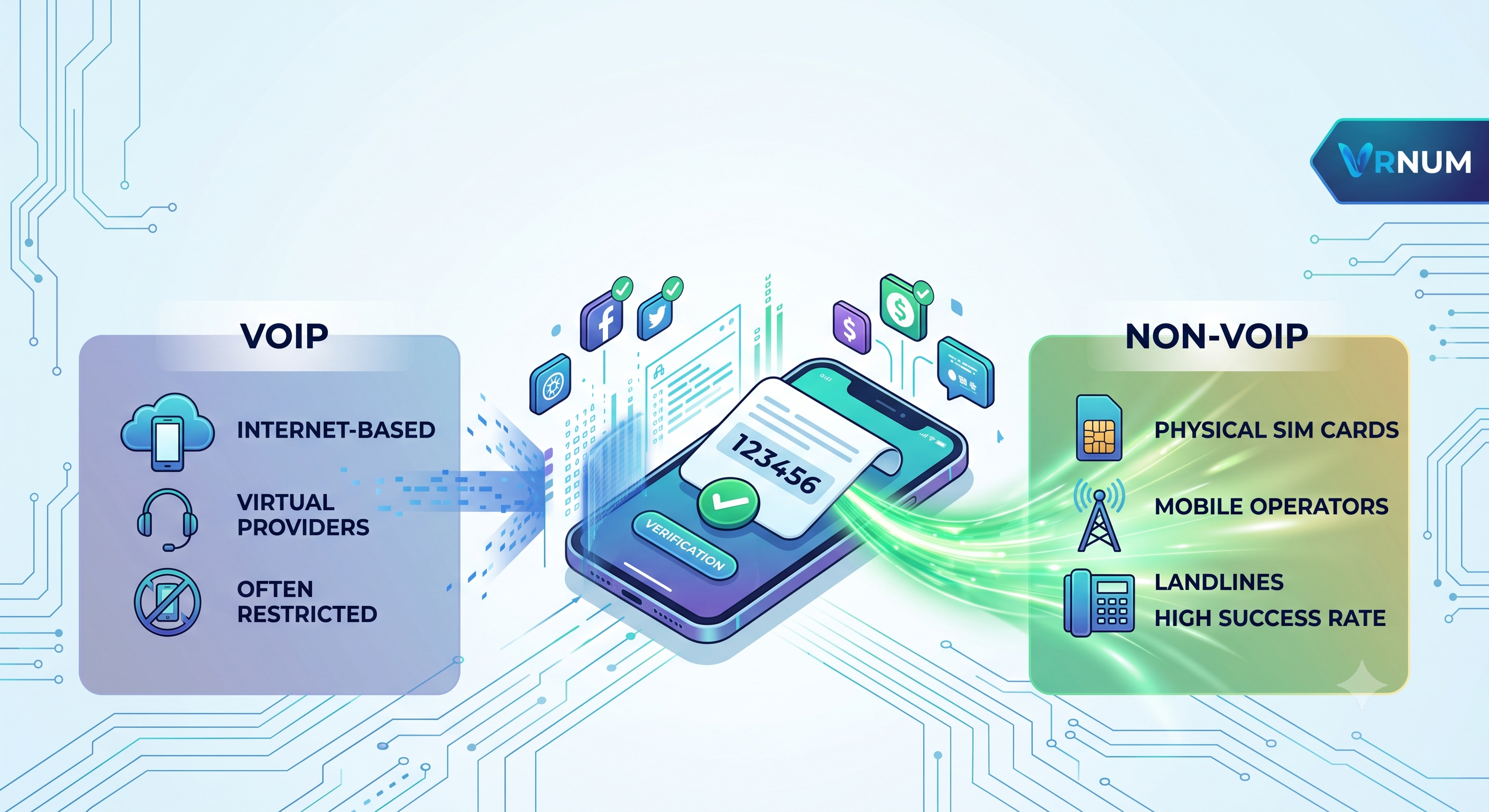
- Mobile — allocated to a licensed mobile carrier network. This is what a physical SIM card in your phone returns, and it's what platforms want to see.
- VoIP — routed over the internet through providers like Google Voice, TextNow, or Skype. Cheap or free to generate in bulk, which is exactly why they're distrusted.
- Fixed line — a landline. Can't receive SMS at all in most cases.
- Unknown — no carrier record found, treated as high-risk by default.
"Non-VoIP" simply means a number that returns as mobile in that lookup — regardless of whether you're holding a physical SIM or using a virtual number. The label a platform cares about isn't "virtual vs. physical." It's which carrier block the number was issued from.
This is the detail almost every "get a free number" tutorial skips, and it's the reason so many virtual numbers fail on exactly the platforms people need them for most.
Why Platforms Block VoIP Numbers in the First Place
VoIP numbers can be generated in bulk, for free, in seconds. That makes them the tool of choice for spam accounts, fake reviews, and mass account creation — so platforms with anything to protect (payments, messaging, identity) run a carrier check and reject anything that isn't mobile-allocated.
This isn't a rumor or a guess — it's a documented, deliberate policy decision at most major platforms, not a technical limitation. We go deeper into exactly how these carrier lookups work — and what a "mobile" classification actually requires — in Real Mobile vs VoIP: How Carrier Detection Works.
The practical effect in 2026:
| Platform | VoIP tolerance |
|---|---|
| Very low — aggressively filters VoIP ranges | |
| Google / Gmail | Low — especially for new account creation |
| Meta (Instagram, Facebook) | Very low — cross-references across all Meta products |
| Banks & fintech apps | Often zero — blocked by policy, stated in ToS |
| Discord, gaming platforms | Moderate — more tolerant, but still filters known-abused ranges |
| E-commerce, forums, newsletters | High tolerance — rarely checks carrier type |
If you're verifying something low-stakes, a VoIP number might work fine. If you're verifying WhatsApp, a bank, or anything tied to money or identity, VoIP is very likely to fail — and no amount of retrying fixes it.
How to Tell If a Number Is VoIP Before You Use It
You don't have to guess and burn an attempt. Before submitting a number anywhere important:
- Check where it came from. Google Voice, TextNow, Skype Numbers, and most "free SMS receive" websites are VoIP by definition — there's no version of these that returns as mobile.
- Ask the provider directly. A legitimate non-VoIP provider will tell you plainly whether numbers come from mobile carrier allocations or VoIP ranges. Vague answers ("real numbers," "high quality") without naming the carrier type are a red flag.
- Run a free carrier lookup. Several free HLR/carrier-lookup tools online will tell you whether a specific number returns as mobile, VoIP, or unknown — worth 30 seconds before you rely on a number for something that matters.
- Watch for the tell in pricing. VoIP numbers are nearly free to generate, so if a "non-VoIP" number is priced identically to known free VoIP services, be skeptical of the claim.
The Best Non-VoIP Number Options in 2026
Not every service that claims "non-VoIP" holds up equally across platforms. Here's an honest breakdown of the main options:
VRNUM
Numbers are issued from licensed mobile carrier allocations, not VoIP pools — the same standard a physical SIM card meets. Two products:
- Virtual Number — a dedicated number you keep for 30 or 365 days, ideal for WhatsApp, Telegram, or any account you're actually going to use long-term.
- OTP Number — single-use, instant, refunded in full if no code arrives.
Zero KYC (email only), crypto-native checkout (BTC, USDT, ETH, LTC), and 50+ countries. The tradeoff: a newer platform with a smaller footprint than the decade-old players below — but the number quality itself doesn't depend on how long a company has existed.
TextVerified
One of the more established non-VoIP-focused services, offering US numbers for SMS and voice verification plus a free tier of shared public numbers. The free numbers are genuinely non-VoIP, but they're shared publicly — anyone can see the codes sent to them, and they're frequently already flagged on major platforms by the time you try them. The paid tier is the more reliable option, priced per verification.
5sim.net
Large, established catalog covering hundreds of countries and services at low per-activation prices. Number quality varies by range — some pass strict platforms consistently, others don't — since the pool spans many underlying carrier sources. Better suited to bulk, lower-stakes activations than to a single account you plan to depend on.
SMSPool
Similar activation-based model to 5sim, with a free tier of non-VoIP US/UK numbers alongside paid options. Reasonable coverage; like most pay-per-activation services, consistency varies by country and platform.
Google Voice / TextNow
Worth naming because they're the first thing most people try — and they're VoIP by definition. They can work for low-security signups but are exactly the category WhatsApp, Meta, and banks are built to detect and block. If a guide recommends these for a platform that explicitly filters VoIP, that's the guide's mistake, not yours.
Comparison at a Glance
| Service | Number type | Payment | KYC | Best for |
|---|---|---|---|---|
| VRNUM | Real mobile carrier | Crypto, cards, wallets | None | Long-term accounts (Virtual Number) or single verifications (OTP Number) |
| TextVerified | Non-VoIP US (paid) / shared (free) | Card, crypto | US-specific verification, willing to pay for reliability | |
| 5sim.net | Mixed carrier sources | Crypto, cards | Bulk, lower-stakes activations | |
| SMSPool | Mixed carrier sources | Card, crypto | Budget activations, free-tier testing | |
| Google Voice / TextNow | VoIP | Free / subscription | Google/phone account | Low-security signups only — expect blocks on strict platforms |
Free vs. Paid Non-VoIP Numbers: What You're Actually Trading Off
Free non-VoIP numbers exist, but the "free" comes with three real costs:
- They're shared. Anyone visiting the same public page can see the code sent to that number — no privacy at all.
- They're pre-burned. By the time a free number is public, it's often already been used to register (and get flagged on) the exact platforms you're trying to verify.
- They're first-come-first-served. Popular services run out of working numbers fast, and there's no guarantee one will be available for your country or platform when you need it.
Paid non-VoIP numbers cost a small amount per use (or a monthly rate for a dedicated one) specifically to remove those three problems: exclusivity, freshness, and availability. For a one-off signup to something low-stakes, free is a reasonable gamble. For WhatsApp, a bank, or anything you're keeping, it usually isn't worth the failure rate.
Which Option Actually Fits Your Situation
- A single verification code for something you won't touch again → A paid OTP-style number is worth the small cost over gambling on a free shared one. Browse OTP numbers →
- An account you're keeping — WhatsApp, a business profile, ongoing 2FA → You need a dedicated number, not a single-use one, or you'll get locked out the first time the platform asks to re-verify. Browse Virtual Numbers →
- Bulk, low-stakes activations across many platforms → A large activation-based catalog (5sim, SMSPool) may suit the volume better than a dedicated-number model.
- You specifically need a US number and don't mind paying per use → TextVerified's paid tier is a reasonable option.
Frequently Asked Questions
What is a non-VoIP phone number?
A non-VoIP number is one that returns as "mobile" in a carrier lookup — allocated from a real mobile carrier network rather than an internet-routed VoIP provider like Google Voice or Skype. Platforms check this classification, not whether the number is "virtual."
How do I know if my number is VoIP or not?
Ask the provider directly whether numbers come from mobile carrier allocations, or run the number through a free online carrier/HLR lookup tool, which will return its classification.
Are virtual numbers the same as VoIP numbers?
Not necessarily. "Virtual number" just describes how the number is delivered to you (no physical SIM required) — it says nothing about the underlying carrier allocation. A virtual number can be issued from a real mobile carrier block and pass as non-VoIP, or it can be issued from a VoIP range and get blocked. The provider's sourcing is what determines which one you get.
Why does WhatsApp reject my VoIP number specifically?
WhatsApp runs a carrier-type check on submission and filters number ranges flagged as VoIP or shared, largely to cut down on spam and mass account creation. This is a deliberate policy, not a bug — switching to a number from a real mobile carrier allocation resolves it in almost every case.
Is a free non-VoIP number good enough for a real account?
For a single, low-stakes signup, it can work. For anything you plan to keep — WhatsApp, a business account, banking — free shared numbers are risky: they're publicly visible, often already flagged, and can run out of availability exactly when you need one.
Related reading
- Real Mobile vs VoIP: How Carrier Detection Works
- Why Your SMS Verification Code Never Arrived
- Best SMS-Activate Alternatives in 2026
Get a Non-VoIP Number Real mobile carrier allocations · 50+ countries · Monthly, yearly, or single-use
Get a Virtual Phone Number
Instant activation · 50+ countries · Monthly or yearly plans
Browse Numbers